
Five Lessons from my 95-Year-Old Grandfather on how to Build a Business That Lasts
Fellow steward,
I had a FLOOD of emotion when I saw Tony, my 95-year-old grandfather, walk into the room on the snowy Friday on January 16, 2026, at our “all hands” company workshop.
I asked him to come to our company meeting because I wanted to honor him.
As I saw him walk in, it took me back to my first year working full-time in the family business.
When I first joined the family business, I was RUNNING AWAY from a career I despised (investment banking).
Now, over a decade later, I’m running TO MY LIFE’S WORK: stewarding a family business to flourish for those who come next.
I asked Tony to stop by the company meeting because I wanted him to see the team he helped build for seven decades. Tony committed his life’s work to Century. Tony did the hard work to keep the story alive. (At Century we call that building with brick.)
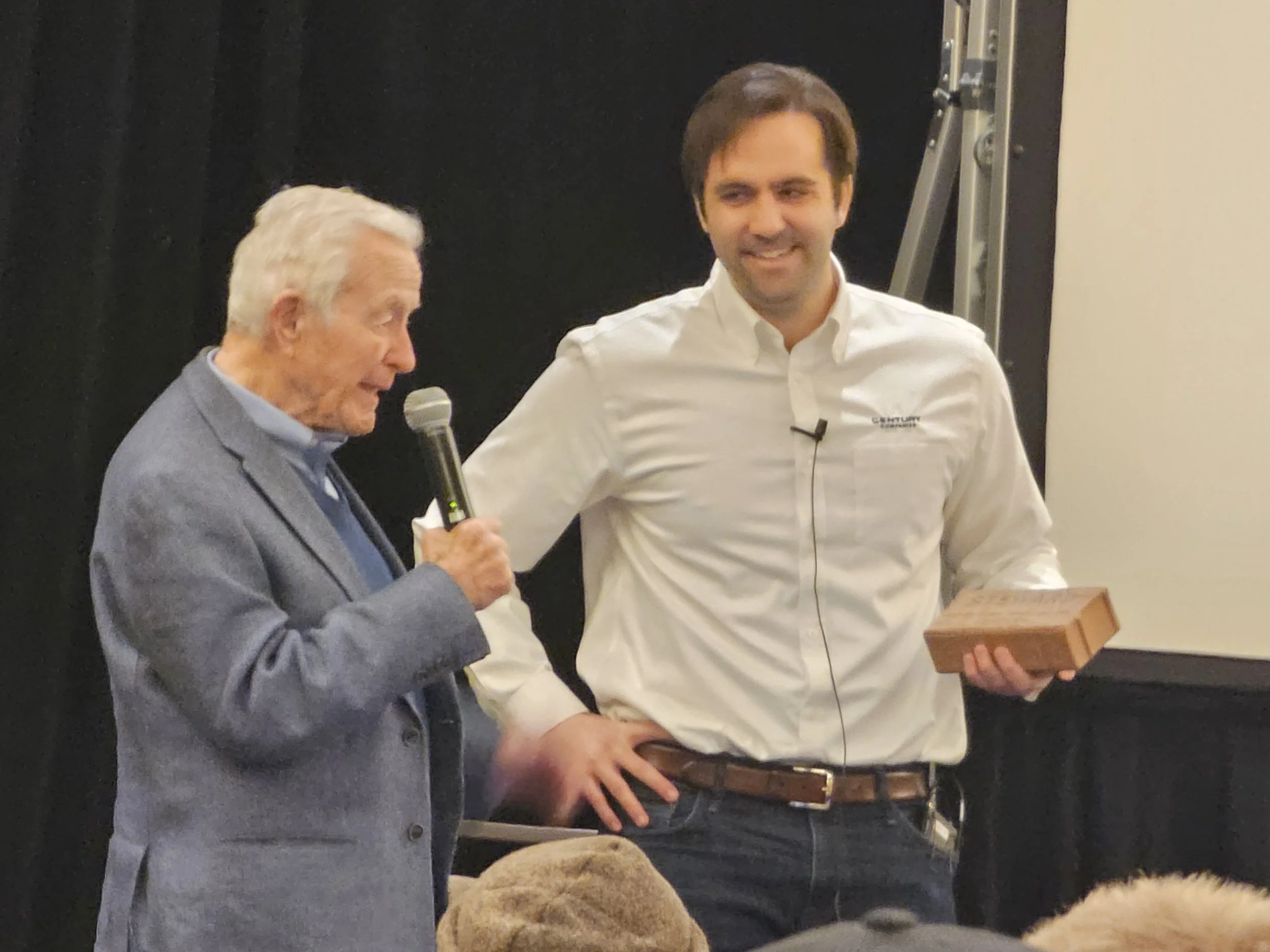
As I handed Tony a small gesture of appreciation, here are the five timeless lessons I’ve learned from spending over a decade walking closely with my grandfather in family business.
1. Deepen relationships for decades.
Every time I’m with my grandfather, he asks me how the team is doing. He’s not asking for the sales numbers or the bottom line. He’s asking about the people. The families.
Play a long-term game with long-term people. You don’t need to play short-term games in business with artificial timelines for a liquidity event.
Business can be a game for decades. You can watch your competitors come and go. You can take action with the learnings over decades of experience. Competitors might be a pain for a little while. Time is the best filter. Most companies won’t do the hard work to last. Let the business compound.
Playing a game for decades allows the most powerful and intangible asset to compound: relationships.
What’s at the backbone of relationships? Trust.
Charlie Munger, co-founder of Berkshire Hathaway, called trust: “the greatest economic force for good.”
Relationships run the world. This is relevant for all stakeholders in a business: employee, customer, vendor, community, and shareholders.
Family businesses that are in the game for decades are in the business of compounding trust.
That takes time. All great things take time.
2. Let people surprise you
For my first seven years in the business, my grandfather and I would spend five hours of windshield time together as we would drive to Minnesota for a company golf event.
It was 2016, we were about 30 minutes into the five-hour drive west, when my grandfather spontaneously stressed to me: “Matt always let people surprise you. You don’t need to tell people how to do everything.”
Nine years later, this is what that statement means to me:
Don’t be a wet blanket. Start with an opening bid of trust. Share the vision. Create and hold the container for what should be done. Let the team accomplish the how.
My grandfather was touching on a timeless truth that most people wake up in the morning wanting to do an incredible job. Life is so much richer when we open ourselves up to the possibility of people sharing their gifts. A family business is the best type of company to provide a space for people to bring their best selves and share their gifts.
What people really want is the opportunity to find mastery, autonomy, and purpose. Creating an environment for that opportunity is what a family business is all about. It takes time. Fortunately, we’ve been playing this game for decades, so we can get better at creating that type of environment for the decades to come.
3. Durable > Growth
My grandfather has always been focused on survival. He grew up in the great depression. Well into his 90s, he would drive around town looking for the cheapest gas. To this day, he will not walk past a penny.
Most people focus just on growth. My grandfather has always prioritized survival. Over nine decades, he’s experienced booms and busts. Over the years, he’s shared with me that you always have the war chest to stay in the game. Business is not linear. Preserve the core.
Being fiscally conservative is a fundamental behavior to play the long-term game. It only takes a couple of minutes without oxygen for the game to be completely over.
4. Real Ownership is Stewardship
Over the decades, Tony never tried to flip the business. He never tried to “maximize” shareholder value.
A steward wants more meaning, not more money.
Leon Bean was asked to sell, and he famously said with laughter: “I don’t need to eat four meals a day.”
A steward serves the organization by creating value rather than extracting value.
Let’s be real. Making a pile of money a bigger pile of money is a pretty silly game to play.
5. Do your life’s work
It doesn’t matter what your life’s work is. Whatever you do. Do it for a long time. Do it with passion. Do it in such a way that you build relationships with good people.
I still have phone calls and receive emails from Tony’s friends checking in on me. (How cool is that!)
The best definition I’ve come across for our life’s work:
Lifelong quest to build something for others that expresses who you are
The beauty of work is finding ourselves along the way. Tony has opened my eyes that the family business is an invitation to optimize for wisdom and relationships. We can go deeper. We can do the things we want to do for a very long time.
Be good. Do good. Do well.
The profits will come. The whole point of this walk on earth is to build relationships and leave this earth a little bit better than when we arrived.
What a gift Tony shared by stewarding a family business for decades, so it can be here for the long haul to play a game worth playing.
Thanks G-Dad!
Onward,
Matt