
The Five Forms of Capital Family Businesses Must Master
The mainstream conversation about money doesn't work for us.
Jim Young from Boiler Room captures the mainstream thought process perfectly:
“They say money can’t buy happiness? Look at the fu**ing smile on my face. Ear to ear, baby.”

Here are some timeless truths I've picked up over three decades about money:
Money amplifies character. Money makes you more of who you are. Money without preparation just leads to consumption.
(Consumption of things is not why we're here on earth.)
If we're not creating, producing, and contributing to something bigger than ourselves, we will not flourish over time. That smile Jim Young refers to won't last.
Building a regenerative family business is really, really hard. It's not sexy. It's not fast. It's not fit for mainstream media.
As a family business, it can be overwhelming to listen to professional investment firms talk about business. There's so much speed and efficiency in unlocking performance.
Most companies have a short time horizon, so it's acceptable to focus only on performance. But focusing only on performance is an effective way for a family business to fail from one generation to the next.
(It's the mainstream approach.)
The interview I highlighted last week with Justin Ishbia can feel hard to compete with because Shore Capital moves so fast. It appears these firms have mastered unlocking performance to accumulate money.
But if we're only focused on performance and fail to see the bigger picture of our people and ourselves, there's a better game to play. A game only privately held businesses can play, businesses that are so much more than a financial instrument for a couple people to win.
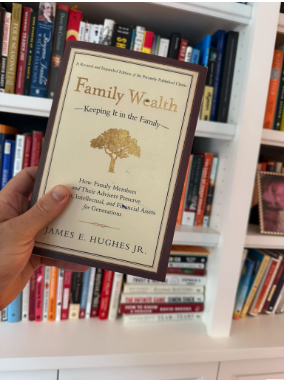
Here's the game. (I found the words for it from Jay Hughes in Family Wealth.)
Financial capital is A form of capital. NOT THE form of capital.
It’s only 1/5th of the forms of wealth.
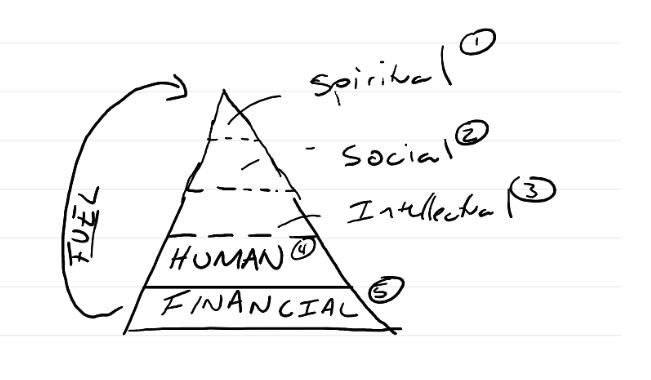
QUALITATIVE CAPITAL
Spiritual Capital (divine connection) - Connected, committed, purpose beyond oneself
Social Capital (relation to others) - Community engagement and connectedness with talent, time, and treasure
Human Capital (good human beings) - Values, morals, ethics, communication, leadership, team building, effective parenting and grandparenting, understanding the psychology of money
Intellectual Capital (learning & sharing what you learn) - Education, skills, careers, coaching & mentoring, gifts, governance, rights and roles of trustees and beneficiaries
QUANTITATIVE CAPITAL
Financial Capital - Medium of exchange to enhance well being and happiness
This relationship to capital gives money a purpose that isn't about accumulation. It pushes a family and a business to be stewards. To enhance and create to amplify service to others!
Purpose is an essential ingredient to do the hard work of transcending generations and building for centuries.
Wealth is well-being.
(Imagine the COMPOUNDING that can occur by optimizing ALL forms of capital.)
I look forward to exploring this in so much more detail with you in the weeks, months, and years ahead.
If a business or family is only focused on unlocking performance, I call this building with straw or sticks. It will not last over the long term.
A business focused on all forms of capital is building with brick.
What an exciting journey.
It's important to keep this top of mind because the quickest way to go out of business and live into the proverb of "shirtsleeves to shirtsleeves" is to focus only on financial capital. (Extraction)
It's not sustainable.
It's imperative for us to know the game we're best positioned to play and not get sucked into someone else's game.
It's a long-term game with long-term people. And it's the most fruitful game you and I are uniquely positioned to play.
I know this concept can feel overwhelming. That's okay. It’s a journey for all of us.
Onward,
Matt